Best Transportation for Large Groups in Miami
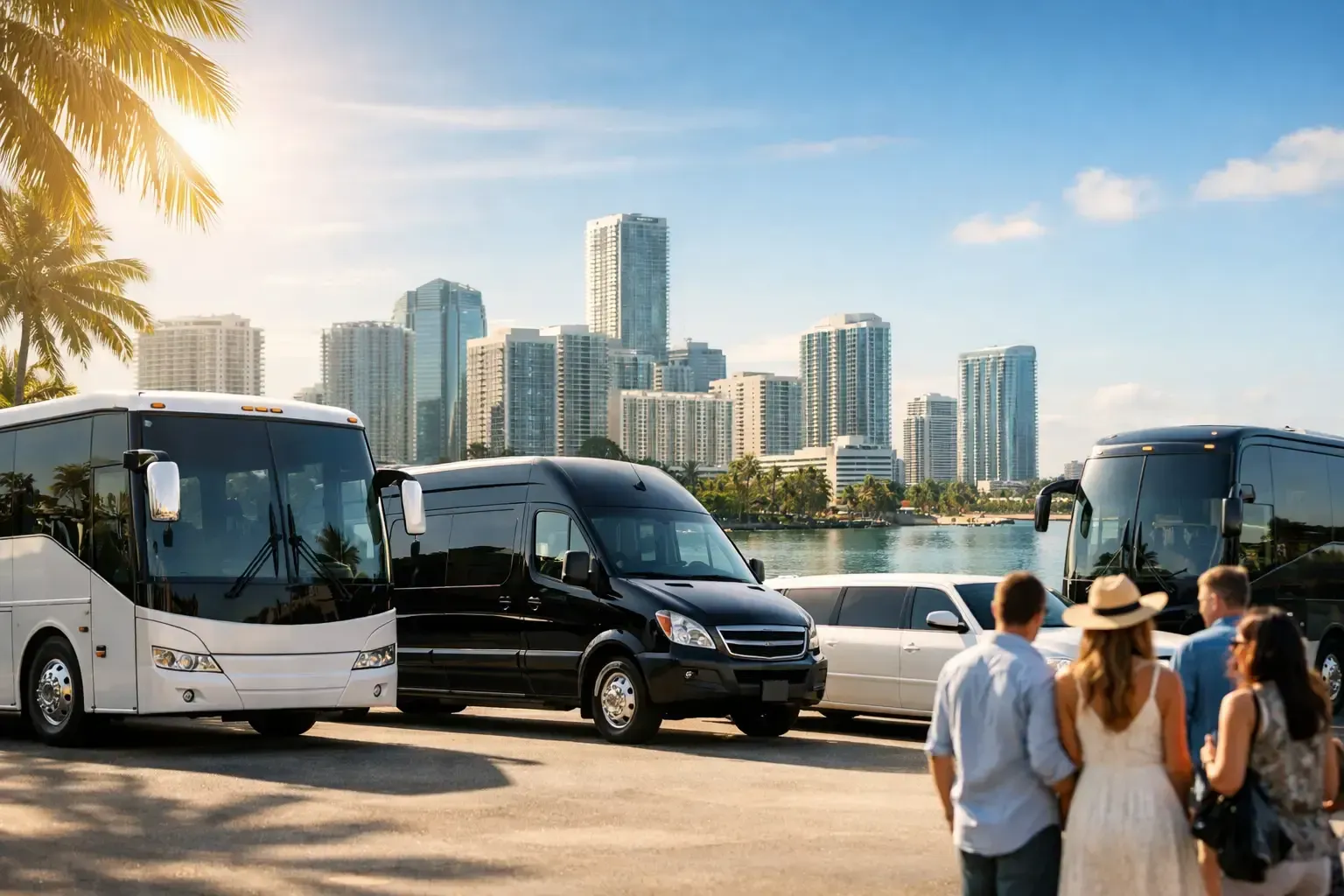
A group of 14 should not arrive at Miami International in five separate rideshares, with half the party waiting at a different terminal and no one certain who has the luggage. The best transportation for large groups is the option that keeps passengers, bags, timing, and service expectations under one coordinated plan.
For corporate delegations, wedding parties, cruise families, convention attendees, and private aviation guests, transportation is not simply a ride between two addresses. It is the first operational decision of the day. In South Florida, that decision has to account for airport pickup rules, I-95 traffic, hotel loading zones, port arrival windows, event schedules, and the practical question that changes every vehicle choice: how much luggage is actually coming along?
What Makes Transportation Work for a Large Group?
Capacity matters, but passenger count alone is not enough. A vehicle that seats 14 may not be the right fit for 14 travelers arriving with international luggage, golf clubs, garment bags, and strollers. Likewise, a 40-passenger motorcoach may be excessive for a 22-person executive group moving between a hotel and a dinner reservation.
The right plan balances four details: headcount, luggage volume, itinerary complexity, and desired experience. A single coordinated vehicle or vehicle fleet gives the group one pickup strategy, a shared arrival time, and a professional point of contact. That is particularly valuable when travelers are unfamiliar with Miami, are arriving on different flights, or need to be at an event at a fixed time.
A premium chauffeured provider also brings an operational layer that on-demand platforms cannot reliably provide. Assigned chauffeurs, dispatch oversight, vehicle staging, and preplanned routes reduce the uncertainty that tends to grow with every additional passenger.
Best Transportation for Large Groups: Match the Vehicle to the Mission
There is no universal answer for every group. The best vehicle depends on where the group is going, how long they will be together, and what they need between stops.
Luxury SUVs for small executive teams and families
For groups of up to six passengers with moderate luggage, luxury SUVs provide privacy, comfort, and direct curb-to-curb service. They work well for executive airport arrivals, family transfers to Miami Beach, FBO pickups, and small groups that may have separate meeting schedules later in the day.
SUVs are not the most efficient solution for larger parties. Booking three SUVs for 15 people can work when discretion or staggered arrivals are priorities, but it requires more coordination than a single van or coach. It is best reserved for groups that value separate cabins or have limited luggage.
Mercedes Sprinter vans for airport and event groups
A Mercedes Sprinter is often the most practical choice for groups of roughly 8 to 14 passengers. It offers easier boarding than a traditional SUV, more upright luggage space, and a shared cabin that keeps the group together. For corporate teams, cruise passengers, and family reunions, that combination is difficult to beat.
Sprinter vans are especially useful for Miami airport transfers because passengers can be loaded and accounted for in one place. They are also well suited to hotel-to-venue service, restaurant transportation, sporting events, and day itineraries that include several stops.
A standard Sprinter prioritizes efficient group movement. A limo Sprinter adds a more elevated interior for celebrations, VIP nightlife, bachelor and bachelorette parties, or guests who want the transportation itself to be part of the occasion. The trade-off is luggage capacity. If the group is traveling with substantial bags, confirm the storage plan before choosing a limo-style configuration.
Mini coaches and motorcoaches for high-volume logistics
For groups of 20, 30, or 40 passengers, a mini coach or motorcoach provides the most controlled solution. It is the preferred format for conference transportation, wedding guest shuttles, cruise transfers, large incentive groups, and airport movements with synchronized arrival and departure windows.
A coach is not only about seating more people. It simplifies the schedule. Instead of tracking multiple drivers and sending updates across a dozen text threads, the organizer has a clear vehicle manifest, designated departure time, and one coordinated route. For event transportation, this can prevent late arrivals caused by guests leaving independently or struggling to find a venue entrance.
Motorcoaches require planning. Hotels, private residences, restaurants, and event spaces may have limited curb access or restrictions on where larger vehicles can stage. A professional transportation team should review loading areas and approach routes in advance, rather than discovering those limitations when guests are already waiting outside.
Plan Around Luggage, Not Just Seats
Luggage is the most common reason a group vehicle plan becomes uncomfortable. A quoted passenger capacity is typically based on people, not the full collection of suitcases that arrives after a week-long vacation or international flight.
For airport and cruise transfers, provide an honest luggage estimate during booking. Include oversized pieces such as golf bags, car seats, folding wheelchairs, instrument cases, and formalwear. A group of 12 with one carry-on each has different needs than 12 cruise passengers with large checked bags.
When space is close, the better choice may be a larger vehicle or an additional luggage vehicle. That decision may feel conservative at the time of booking, but it protects the arrival experience. No client wants their first impression of Miami to be a crowded cabin with bags on laps and a delayed departure from the curb.
Build Time Into the South Florida Schedule
Miami transportation is highly time-sensitive. MIA, Fort Lauderdale-Hollywood International Airport, PortMiami, Miami Beach hotels, Downtown, Brickell, Hard Rock Stadium, and Palm Beach County can all be part of the same itinerary, but they do not operate on the same timeline.
Airport pickups require special attention. Flight delays, terminal changes, customs processing, baggage claim, and arriving passengers who need a moment to reconnect with their group can all affect departure time. Live flight tracking and meet-and-greet service create a more composed arrival, particularly for international travelers, senior family members, executives, and first-time visitors.
For cruise transfers, guests should leave room for port traffic and ship boarding requirements. For weddings and corporate events, transportation should be scheduled around the real start time, not the invitation time. If a ceremony begins at 6:00 p.m., the group should be seated and settled before 6:00 p.m., not pulling into the driveway at that hour.
Hourly chauffeur service is often the strongest option for itineraries with variable timing. It gives the group a dedicated vehicle and chauffeur between meetings, meals, site visits, photo stops, or evening venues. Point-to-point service is more efficient when the plan is simple and the pickup and drop-off times are firm.
Choose One Transportation Lead
Large-group travel goes smoothly when one person has authority to confirm the itinerary, passenger count, contact numbers, and final vehicle plan. That person does not need to manage every guest. They simply need to be the reliable connection between the group and the transportation team.
Before the service date, confirm pickup addresses, flight details, event entrance instructions, stop times, and any special requests. For weddings, designate a planner, family member, or coordinator who can communicate last-minute changes. For corporate groups, provide the on-site contact and a passenger manifest when appropriate.
At 515 MIAMI, this coordination is handled as a transportation operation rather than a collection of individual rides. That matters when a group needs airport arrivals tracked, multiple vehicles staged, or a coach routed through a busy event district with limited access.
When Multiple Vehicles Are Better Than One
Keeping everyone together is usually ideal, but not always. Multiple vehicles make sense when arrivals are separated by several hours, travelers have different hotel destinations, or the group includes VIPs who require additional privacy. They can also be the safer choice when luggage volume exceeds what a single passenger vehicle can accommodate.
The key is to treat multiple vehicles as one plan. Each chauffeur should have the same itinerary, appropriate passenger assignments, and clear instructions for the final destination. Groups should not have to coordinate vehicle-to-vehicle communication on the move.
For the most reliable result, choose transportation based on the complete itinerary, not a seat count on a booking screen. A properly sized vehicle, realistic time allowance, and experienced chauffeur team give every guest the same thing: a calm, organized start to their time in South Florida.
Need a chauffeur in South Florida?
Airport transfers, corporate travel, cruise ports, and events — with flight tracking and chauffeurs who arrive early. Available 24/7 across Miami, Fort Lauderdale, and Palm Beach.