International Visitors in Miami: What the Tourism Data Says About Airport Transportation

Miami-Dade County welcomed 28.3 million visitors in 2025, generating a $32.2 billion economic impact, according to the Greater Miami Convention & Visitors Bureau. Those are the headline numbers. The more useful ones, for anyone thinking about how visitors actually move through this city, sit underneath them.
Nearly half of the traffic through Miami International Airport is international. That single fact shapes the arrival experience more than any other, and it explains why ground transportation that works fine for a domestic weekend trip often falls apart for a family landing from Bogotá at six in the morning.
The scale of the international arrival
MIA handled 55.3 million passengers in 2025, with international travelers making up 45 percent of them and domestic travelers 55 percent, per the Miami-Dade Aviation Department. That works out to roughly 25 million international passengers in a single year, through one airport.
The airport reports service to 190 destinations with 57 passenger carriers offering nonstop flights, and ranks as the second-busiest U.S. airport for international passengers. Average daily traffic ran about 151,500 passengers.
The operational consequence is that international arrivals are not concentrated in one hall at one hour. They are spread across terminals, carriers, and a schedule that runs from before dawn to late at night. There is no single "arrivals curb" where a driver can reasonably expect to find someone.
Where Miami's international visitors come from
The Bureau lists the leading international source markets as Colombia, Brazil, the United Kingdom, Canada, Mexico, Argentina, Spain, Italy, Germany, and France.
Read that list again with ground transportation in mind. Five of the top ten are Spanish-speaking markets, one is Brazil, and four are European. This is not a predominantly English-speaking arrival population, and it is not one with a shared set of assumptions about how airport transfers work, what they should cost, or how they are paid for.
Why the source market changes the arrival
Long-haul flights from South America and Europe cluster at particular hours. Overnight services from the southern hemisphere and from Europe deliver passengers in the early morning, after a night in a seat, into a customs queue, before the city has properly opened.
That is precisely the moment when an arrangement that depends on the passenger doing something — finding an app, walking to a designated pickup level, negotiating a fare, explaining an address in a second language — is most likely to go wrong.
What international visitors spend
Total visitor spending in Miami-Dade reached $22.7 billion in 2025, a 4.1 percent increase over the previous year, with lodging alone accounting for $10.4 billion. The Bureau reports that international visitors spent more than $1,150 per person, per trip, on average.
That figure is worth sitting with. The ground transfer is usually a small fraction of that spend, and it is also the very first thing the visitor experiences after clearing customs. A trip that begins with forty minutes of confusion in a parking garage has spent its first impression badly, whatever the hotel is like.
Tourism supports more than 216,000 jobs in Miami-Dade, around 10 percent of county employment. The arrival experience is not a marginal detail of that economy. It is the front door.
Where the arrival actually breaks down
Three failure points show up repeatedly, and all three are more likely on an international arrival than a domestic one.
The first is timing. Customs and baggage add a variable delay that no published landing time accounts for. A pickup scheduled from the scheduled arrival time is a guess. A pickup arranged around the actual flight, tracked in real time, is not.
The second is the meeting point. A passenger who has never been through Miami International Airport does not know which level, which door, or which garage. Instructions delivered by text message in a language they do not read fluently do not solve this.
The third is the vehicle. International trips run longer and carry more luggage than domestic ones. A sedan booked for four passengers with two weeks of bags is a problem discovered at the curb, which is the worst possible place to discover it.
What the data implies for ground transportation
None of this argues that every visitor needs a chauffeur. It argues that the arrivals most exposed to friction — long-haul, non-English-speaking, arriving tired with real luggage — are exactly the ones a pre-arranged service is built for.
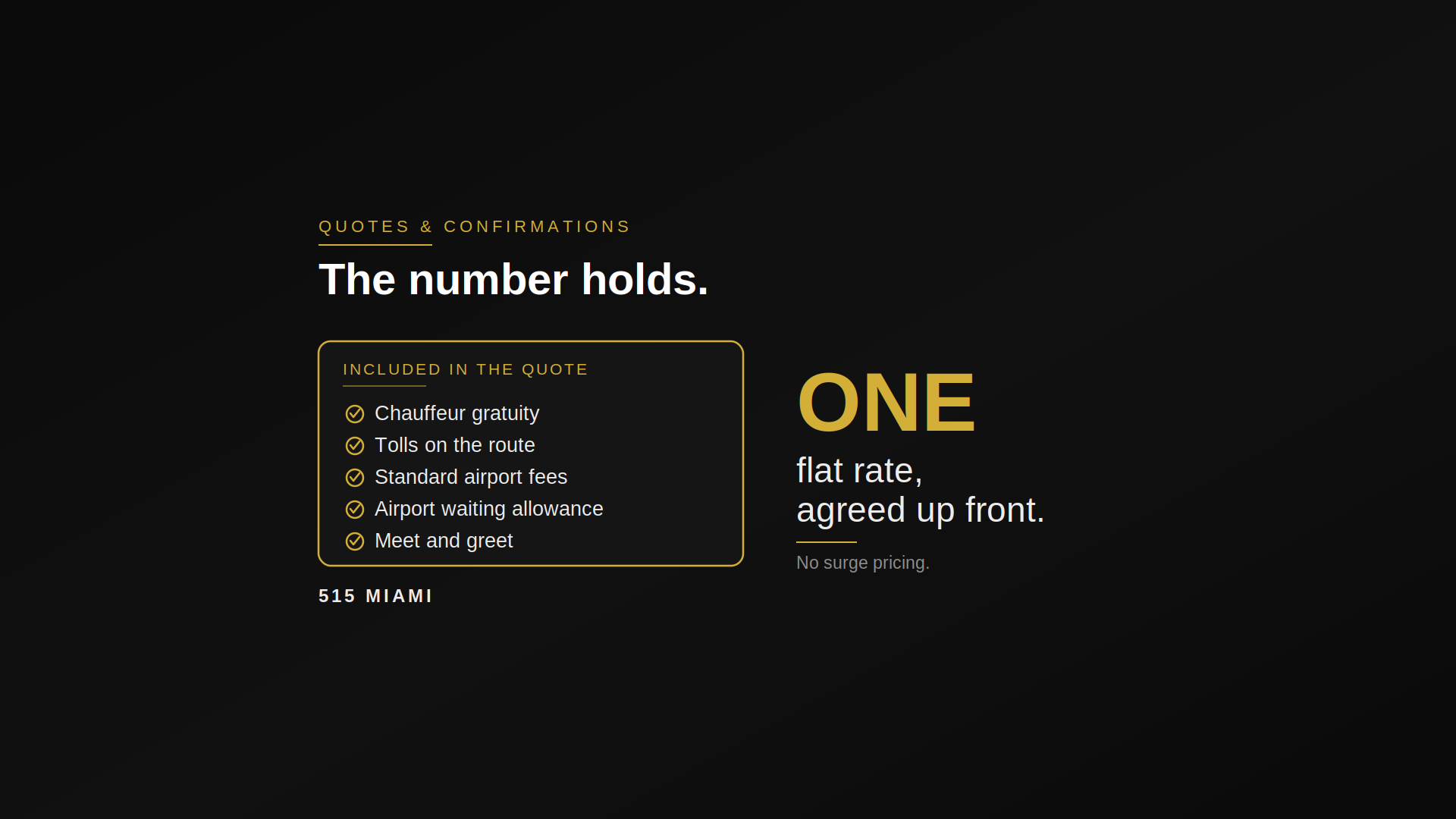
In practice that means four things: the flight is tracked rather than assumed, the chauffeur meets the passenger inside the terminal rather than texting from a garage, the price is agreed before the trip rather than surged after it, and someone in the chain speaks the passenger's language. A proper meet-and-greet service exists to remove the exact decisions a jet-lagged arrival is least equipped to make.
The vehicle should also be assigned from the real passenger and luggage count rather than the headcount alone. It is a small thing to confirm at booking and an expensive one to fix at the terminal.
Miami is a gateway, not only a destination
A significant share of international arrivals are not stopping in Miami at all. They are connecting to a cruise port sailing, driving on to Orlando or the Keys, or joining a multi-city itinerary that starts here.
Those trips carry a hard deadline. A ship does not wait, and a missed sailing is not a rescheduled ride. When the transfer is the link between an international flight and a fixed departure, the planning has to account for customs, traffic, and the gap between the two — not just the mileage.
The first impression is a logistics problem
The tourism data does not say that Miami has a transportation crisis. It says something more specific: that a quarter of the people arriving through its main airport each year are international, that they come disproportionately from Latin America and Europe, that they spend at a premium, and that they land in the conditions least forgiving of a vague plan.
Those are solvable conditions. Track the flight, meet the passenger inside, agree the price, size the vehicle, and speak the language. The data does not demand more than that, and it does not forgive much less.
Sources
Visitor volume, spending, employment, and international source markets: Greater Miami Convention & Visitors Bureau, 2025 tourism performance report.
Passenger volume, international share, destinations, carriers, and rankings: Miami-Dade Aviation Department, Miami International Airport passenger statistics.
All figures reflect calendar year 2025 and were current at the time of publication.
Need a chauffeur in South Florida?
Airport transfers, corporate travel, cruise ports, and events — with flight tracking and chauffeurs who arrive early. Available 24/7 across Miami, Fort Lauderdale, and Palm Beach.