Uber Black vs. a Private Chauffeur in Miami: What the Price Difference Actually Buys
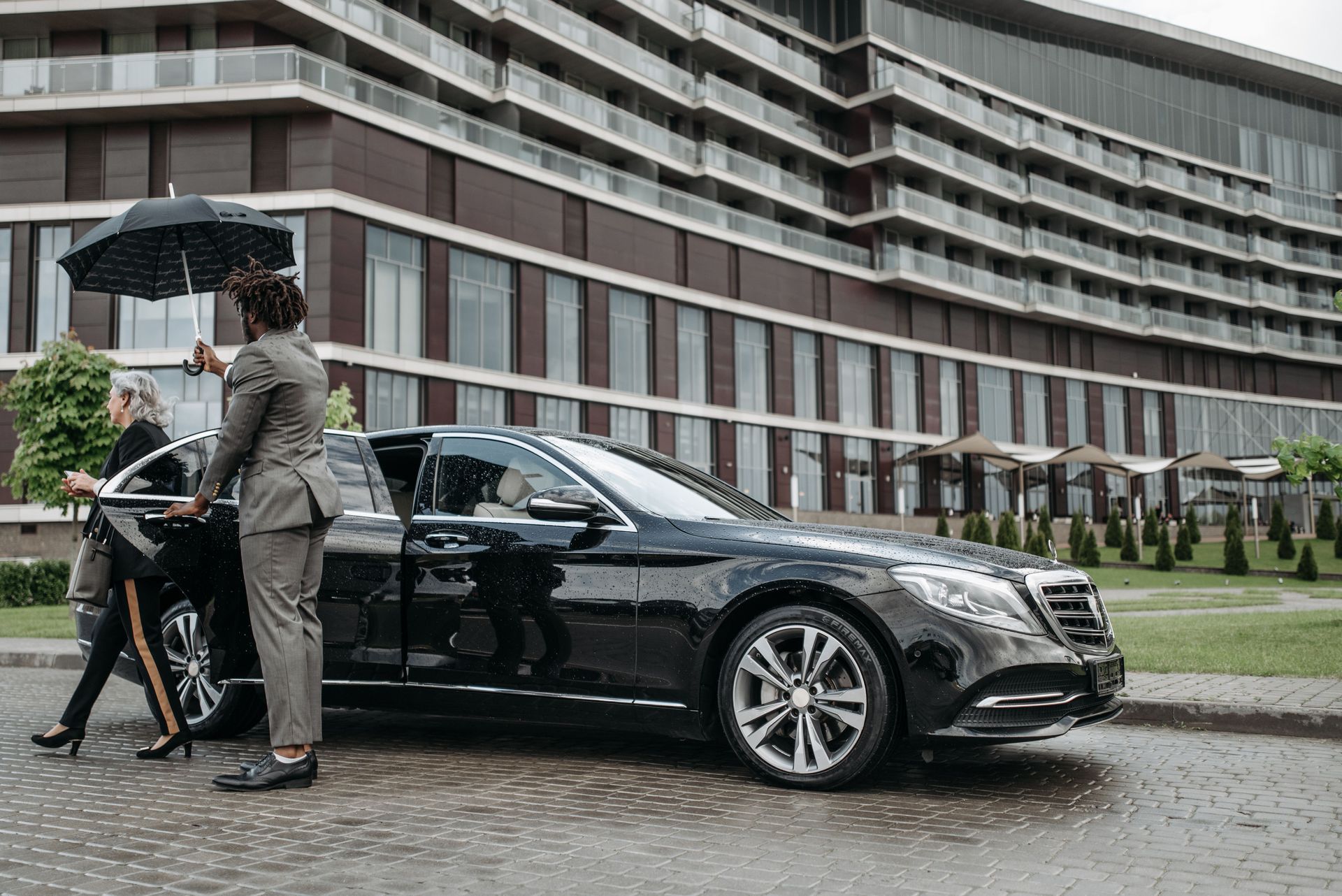
Both send a black sedan. The gap is the contract underneath the ride — who is obligated to show up, what happens to the price when conditions change, and who answers the phone at 5 a.m.
Open the app at Miami International and Uber Black will quote you a number. Call a chauffeur company for the same route and you will usually hear a higher one. The obvious conclusion is that you are paying extra for the same black car, and on a good day — light traffic, an on-time flight, one passenger with a carry-on — that is close to true.
The gap is not really about the car. Both services will pull up in a dark sedan with leather seats. What separates them is the contract underneath the ride: who is obligated to show up, what happens to the price when conditions change, and who is accountable when something goes wrong at 5:40 in the morning on the way to a ship. That is what the difference buys, and it is worth knowing before you decide it is not worth paying.
What Uber Black actually screens for
It is worth giving the product its due, because Uber Black is not UberX with a car wash. Uber’s own published requirements are specific, and they are stricter than most people assume.
- The driver must be a professional driver carrying commercial auto insurance. Uber states plainly that personal auto insurance does not qualify.
- The driver must hold all permits required by their city to operate a commercial livery vehicle.
- The driver must maintain a 4.85 rating or above, calculated across their most recent 500 trips. Fall below it and the rating is reassessed every 50 trips before requalification.
- The vehicle must be no more than five model years old, from a specific approved list of makes and models.
- The vehicle must have a black exterior and a black leather or vegan leather interior.
That is a genuine standard. A commercially insured, county-permitted driver in a late-model black sedan is not a downgrade from a chauffeur — in Miami-Dade, the two are frequently the same person. Every for-hire driver in the county, whether they are behind the wheel of a taxi, a limousine, or an Uber Black, has to obtain a chauffeur registration from the County, complete its training program, and pass the exam for their license type.
So the screening is real. What the screening cannot do is change the shape of the transaction.
A marketplace request is not a reservation
This is the difference that matters most, and it is the one Uber is most transparent about.
Uber Reserve lets you book up to 90 days ahead and removes demand pricing — the marketing language is “no surges or spikes,” and that part is accurate. But read the Reserve terms and the structure becomes clear: Uber does not guarantee that a driver will accept your reservation request, and a status of “Reservation Confirmed” does not mean a driver has accepted it. Your ride is confirmed when driver details actually appear.
That is not a criticism of Uber. It is an honest description of how a marketplace works. Uber does not employ the driver or own the car; it matches supply to demand, and at 4:00 a.m. on a Tuesday in August the supply that matches your request is whatever is awake. The system is optimised for coverage across millions of trips, not for the certainty of your one trip.
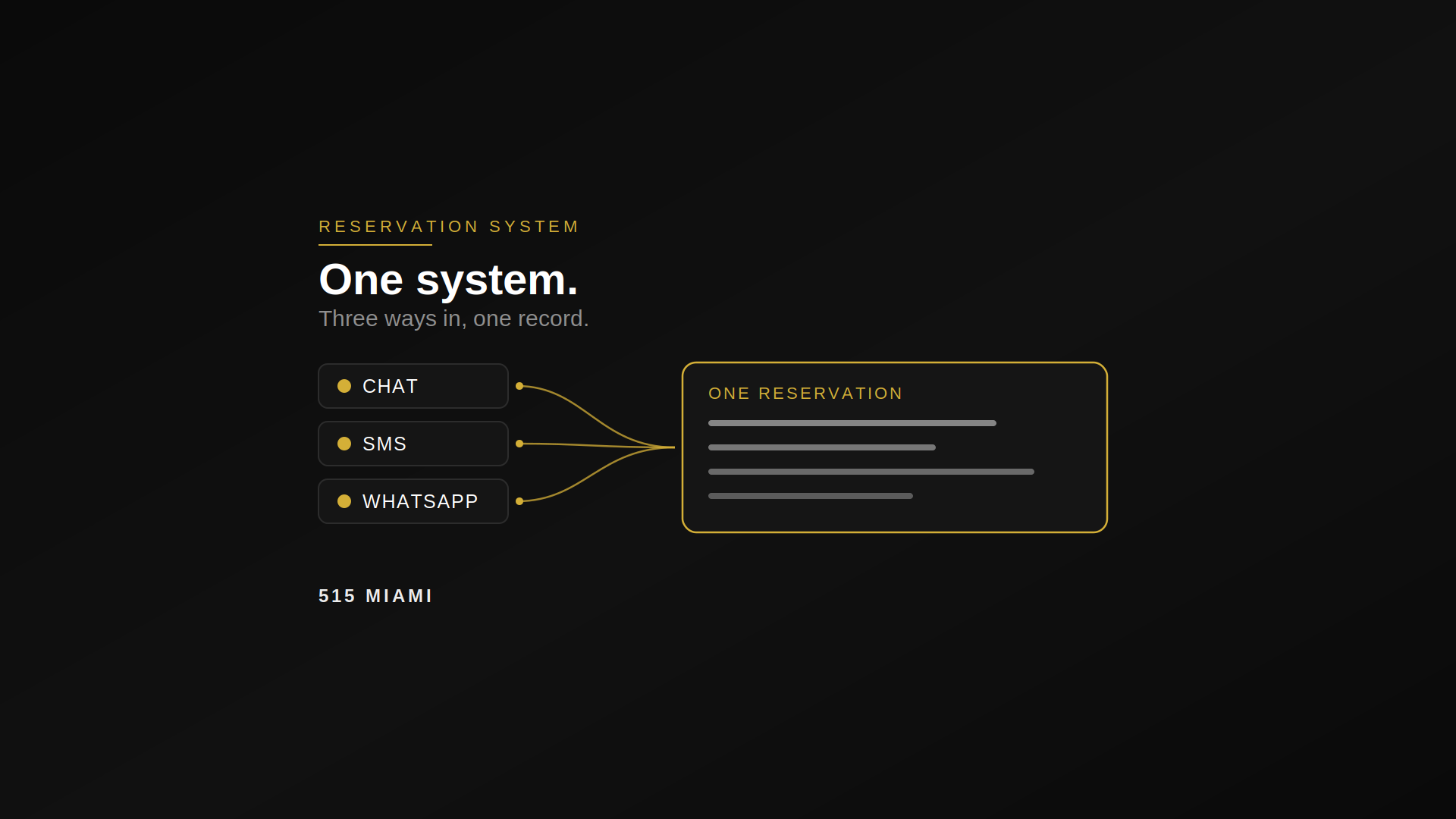
A chauffeur company is built the other way around. When a reservation is accepted, a specific vehicle and a specific chauffeur are assigned to it, and dispatch is responsible for that assignment being met. The obligation runs to you rather than to a matching algorithm. That is most of the price difference right there, and it is worth precisely nothing on an easy Tuesday afternoon and quite a lot at 4:00 a.m.
Two different answers to a delayed flight
Miami International handles a lot of international arrivals, and international arrivals are where ground transportation plans go to die. Immigration queues, a baggage belt that takes forty minutes, a connection that pushed your landing back two hours.
On the app side, a scheduled pickup that has not been matched yet does not know your aircraft is late. If you booked for 6:00 p.m. and you clear customs at 7:35, you are re-requesting in the arrivals hall along with everyone else on your flight, at whatever the market is charging at that moment.
A flight-tracked booking works differently. Our MIA pickups are tied to your flight number, so the pickup time moves with the aircraft rather than staying pinned to the time you guessed at when you booked. Quoted rates carry a grace period from touchdown — 60 minutes on international arrivals, 40 minutes on domestic, and 30 minutes at private aviation terminals — after which additional time bills in 30-minute increments. The delay is planned for rather than penalised.
The curb is part of the product
There is a smaller difference that travelers consistently underrate until they are standing in it with luggage.
Ride app pickups at MIA happen at designated doors on the first level (arrivals) and second level (departures). You collect your bags, read a door number off your phone, and walk to the vehicle. It works, and for a solo traveler with a roller bag it is completely fine.
Pre-arranged chauffeur service is a different choreography: the chauffeur is inside the terminal with a name sign, takes the bags, and walks you to a car that is already staged. On airport transfers that is the whole point of the booking — not luxury for its own sake, but the removal of the twenty minutes where a tired family, four checked bags and a phone with 6% battery have to find door 17.
The airport itself makes a related point worth repeating: MIA warns travelers to ignore offers of transportation from solicitors inside the terminal, because soliciting ground transportation is illegal there and many of the people doing it are unlicensed and uninsured. A pre-arranged pickup and an app booking are both legitimate. The person who approaches you at baggage claim offering a ride is neither.
Price certainty, and what “flat rate” has to mean
On-demand Uber Black moves with demand. That is the trade you accept for instant availability, and the multipliers land exactly where you would expect them to in this city: the Friday evening arrivals bank, Art Basel week, Ultra weekend, cruise turnaround Saturdays at the port, and any afternoon a storm cell parks over the airport.
Reserve solves the surge problem and introduces two smaller ones. Uber states that Reserve pricing carries a built-in premium over on-demand rates, and that the price can still increase if the length, duration, or route of the trip changes. Cancellation fees on Reserve are higher than on-demand.
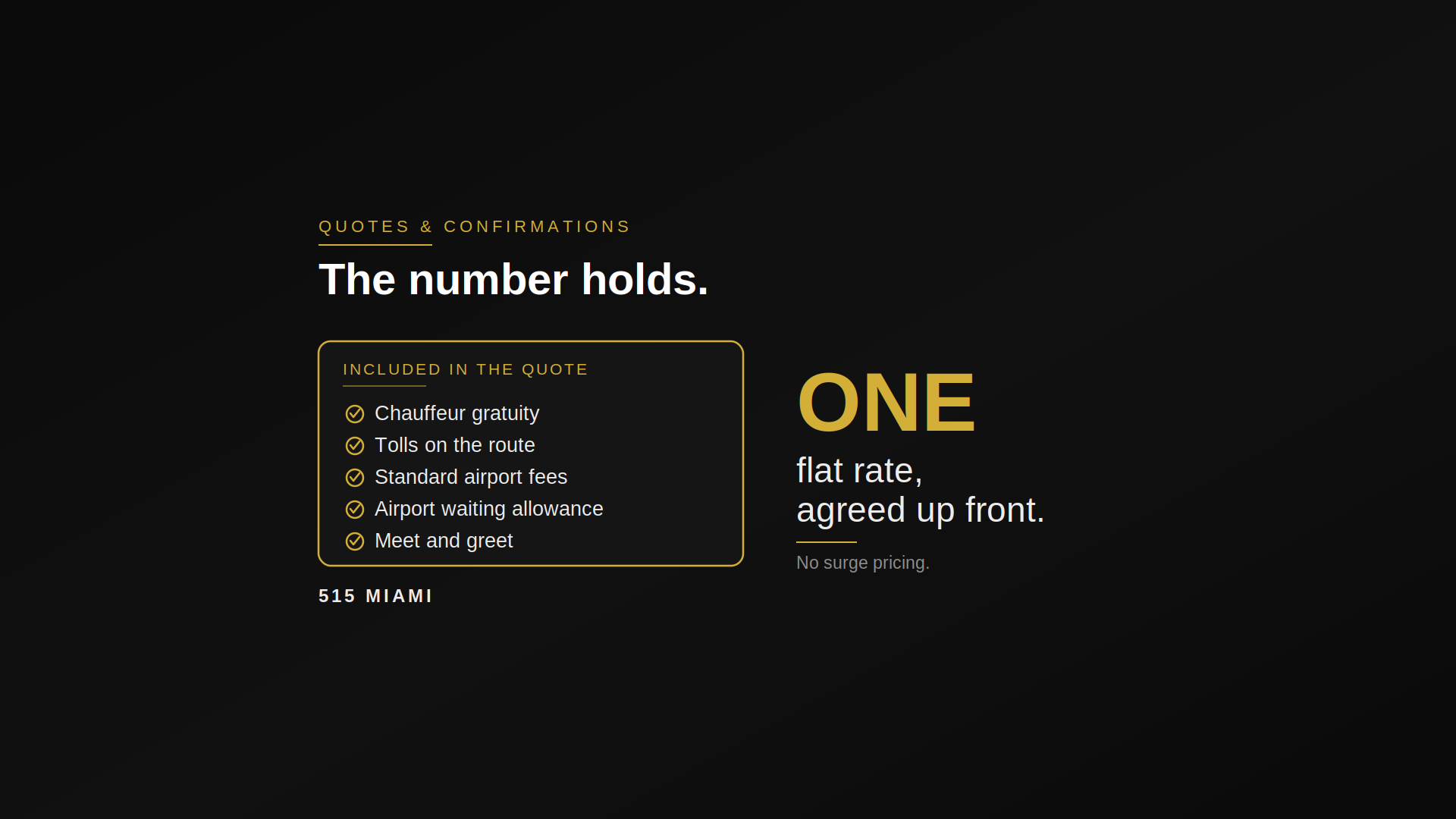
A chauffeur flat rate is a different promise: one all-inclusive figure agreed before the trip, calculated from route, vehicle class, and time of day, with tolls, fuel, gratuity, and meet-and-greet already inside it. The number does not move because the Dolphin Expressway did. On any metered or demand-priced fare, the traffic risk sits with the passenger. On a flat rate it sits with the operator, which is the entire reason the quoted figure looks higher at the moment you compare them.
If you want the full breakdown of how the other options price the same trip, we worked through the county meter, rideshare, and black car rates route by route in what a car service actually costs in Miami.
Where accountability actually sits
When an app trip goes wrong, the recourse is a support ticket. When a chauffeur booking goes wrong, the recourse is a dispatcher who knows your name, your flight, and the chauffeur’s phone number, and who can put a second vehicle on the road while you are still talking.
That difference has almost no value on a routine transfer and enormous value on the trips where the downside is not a refund. A wedding party that has to be at the venue at a fixed time. A board member you are collecting personally. A PortMiami sailing where the ship leaves without you. In those cases you are not buying a nicer ride, you are buying somebody whose job it is to make sure the ride happens.
It also shows up in the vehicle itself. Uber Black guarantees a category — a late-model black sedan with a black interior. A chauffeur booking is for a named vehicle: a specific S-Class, Escalade, or Sprinter assigned to your reservation. If you are putting six people and six bags in a car, the difference between “an SUV” and “this SUV” is the difference between a plan and a hope.
When Uber Black is genuinely the right call
Plenty of the time. If you are traveling alone or as a couple with hand luggage, off-peak, on a domestic flight that is running on time, to a hotel with a normal driveway — take the app. It will be cheaper, it will be quick, and the extra structure you would be paying a chauffeur company for is structure you do not need on that trip. Anyone who tells you otherwise is selling something.
The calculation flips on a fairly short list of conditions:
- Groups. Once a party needs a second vehicle, one SUV or Sprinter at a single flat rate usually beats two demand-priced cars, and it keeps the group and the bags together.
- Hard deadlines. Cruise departures, a flight you cannot miss, a ceremony with a start time.
- Event weeks. Art Basel, Music Week, race weekend, boat show — when a rate locked in advance is immune to what everyone else is paying.
- Multi-stop days. Around the third stop, hourly or as-directed service typically undercuts a string of separate bookings, and the vehicle and your belongings stay with you between meetings.
- Client-facing arrivals. When the pickup is part of the impression you are making.
The questions that make the two comparable
Most Uber Black versus chauffeur comparisons are unfair in both directions, because people compare a best-case app price against a worst-case chauffeur quote. Four questions make them line up.
Is gratuity inside the number? A 20 percent difference hides in that answer alone. Ask it of both.
Are tolls and airport fees included? South Florida’s expressways are almost entirely tolled, and the fees are real either way — the only question is whether they are quoted or added.
What happens if the flight is late? This is the question that separates the two products more than any other. Ask what the included wait is, and what happens after it.
Is the vehicle assigned or matched? Not which car is nicer — whether a specific car has your name on it, or whether one will be found for you closer to the time.
Common questions
Is Uber Black the same as a black car service?
They overlap but are not identical. Uber Black is a tier within a marketplace: a commercially insured, city-permitted driver in an approved late-model black vehicle, matched to you at the time of the trip. A black car service is a company that assigns a specific vehicle and chauffeur to your booking in advance and is accountable for that assignment. In Miami-Dade the driver may hold the same county chauffeur registration in both cases.
Does Uber Reserve guarantee a car will show up?
No. Uber’s Reserve terms state that Uber does not guarantee a driver will accept your reservation request, and that a “Reservation Confirmed” status does not mean a driver has accepted. The trip is confirmed once driver details are provided. Reserve does remove demand pricing, and rides can be booked up to 90 days ahead.
Is Uber Black cheaper than a private chauffeur in Miami?
On a single off-peak transfer with light luggage, usually yes. The comparison narrows or reverses with groups, event-week demand pricing, delayed international arrivals, and multi-stop days, because a flat rate absorbs the variables that an app fare passes through to the passenger.
Does Uber Black include gratuity?
Tipping in the Uber app is optional and added by the rider after the trip, so it sits outside the quoted fare. At 515 MIAMI, gratuity, tolls, fuel, and meet-and-greet are quoted inside the flat rate. When comparing the two numbers, make sure they contain the same things.
Can Uber Black meet me inside the terminal at MIA?
Ride app pickups at Miami International are at designated doors on the first level (arrivals) and second level (departures) — you walk out to the vehicle. Terminal meet-and-greet with a name sign is a feature of pre-arranged chauffeur service rather than an app booking.
Do Uber Black drivers need a commercial license in Miami?
Uber requires Uber Black drivers to carry commercial auto insurance and hold the permits their city requires to operate a commercial livery vehicle. Separately, Miami-Dade County requires every for-hire driver — taxi, limousine, or otherwise — to obtain a County chauffeur registration and complete its training program.
Sources
- Uber, Uber Black driver requirements (accessed August 2026)
- Uber, Uber Reserve product page and Uber Reserve Terms of Use (accessed August 2026)
- Miami International Airport, Taxis & Ride App ground transportation page (accessed August 2026)
- Miami-Dade County, For-Hire Chauffeur License & Training Program (accessed August 2026)
Uber product terms and Miami-Dade licensing requirements change. The descriptions above reflect the published policies at the time of writing; check the current terms in the app before booking.
Need a chauffeur in South Florida?
Airport transfers, corporate travel, cruise ports, and events — with flight tracking and chauffeurs who arrive early. Available 24/7 across Miami, Fort Lauderdale, and Palm Beach.