Miami to Boca Raton and West Palm Beach: A Corporate Route Timing Guide
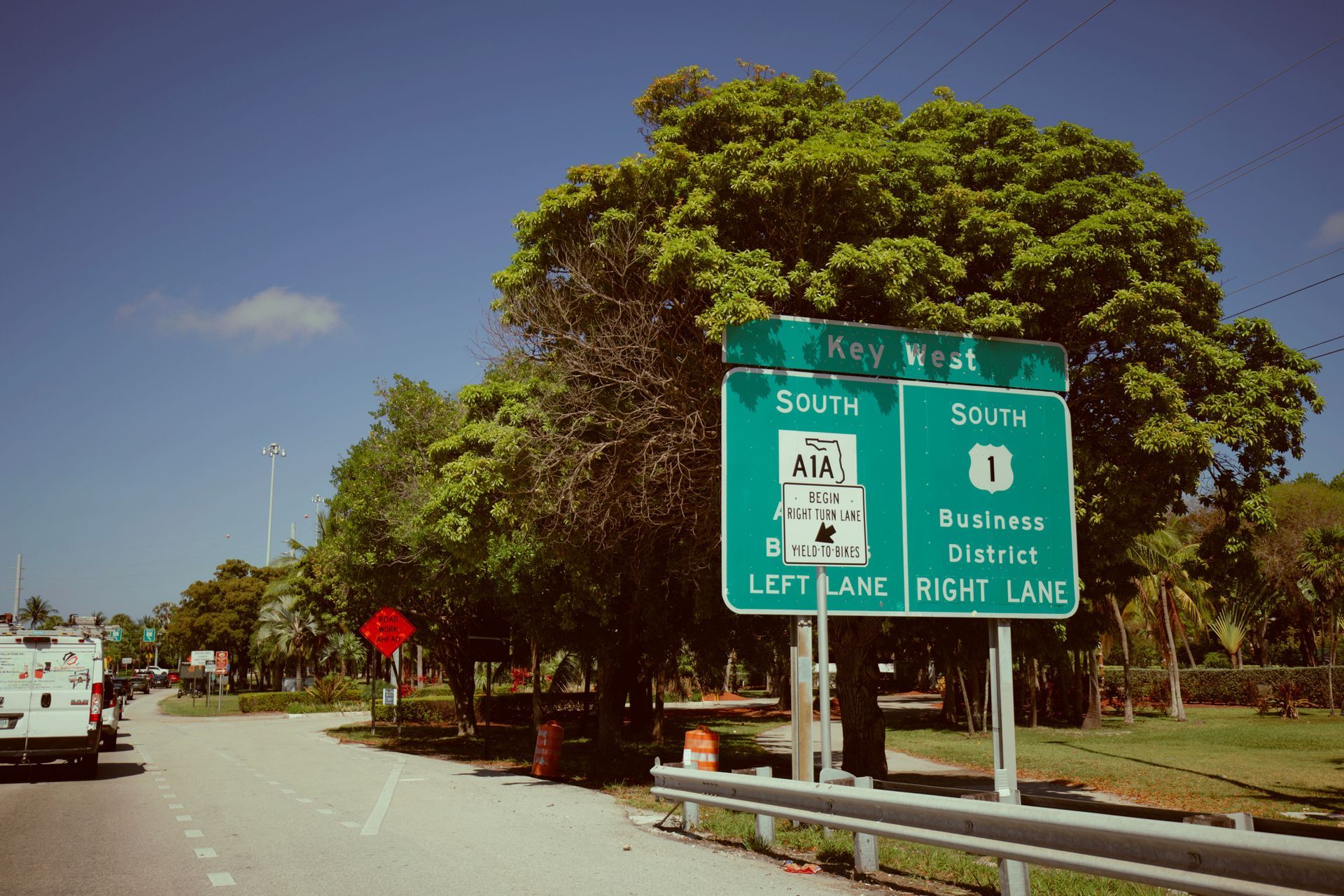
Seventy miles, three counties, two highways, and an airport that just changed its name
Most corporate itineraries in South Florida treat "Miami to Boca Raton" as a single number. It is not a number. It is a range, and the range is wide enough to lose a meeting in.
The corridor from downtown Miami up to West Palm Beach runs about seventy miles through three counties, on two parallel highways that behave nothing like each other, into an airport that changed its name and its code this summer. If you are running executives up this corridor, the useful skill is not knowing the drive time. It is knowing which variables move it, and by how much.
The corridor, in round numbers
Three distances anchor everything else.
Downtown Miami to Boca Raton is roughly 45 miles. Downtown Miami to West Palm Beach is roughly 70 miles. Fort Lauderdale sits almost exactly in the middle, which is why so many South Florida corporate days end up hubbed there.
Those numbers are stable. The time it takes to cover them is not. The same seventy miles can run comfortably under ninety minutes on a Sunday morning and well past two hours on a weekday afternoon, and nothing about the road changed in between. Any plan that budgets one figure for both cases is really budgeting for the good case and hoping.
The airport question comes before the route question
Before you plan the drive, plan the arrival, because choosing the wrong airport adds more time than any routing decision will ever save.
For a meeting in West Palm Beach, the closest commercial airport is the one formerly known as Palm Beach International. It was renamed President Donald J. Trump International Airport effective July 9, 2026, and its three-letter airline code changed from PBI to DJT on August 18, 2026. The airport's own guidance is that routes, schedules and airline operations are unaffected — but the code in your booking system, your traveler's app and your ground transportation request should now read DJT. Expect to see PBI lingering in older itineraries and third-party tools for a while yet.
It is also the easiest of the three to reach from the highway: the Palm Beaches tourism authority lists it at Exit 69 off I-95, or via the Southern Boulevard exit from Florida's Turnpike.
For Boca Raton, Fort Lauderdale–Hollywood International is usually the better commercial arrival than Miami International, simply because it removes twenty-five miles of the corridor's worst stretch from the ground leg. We cover both in more detail on our Fort Lauderdale airport and Palm Beach airport pages.
Miami International remains the right choice when the international schedule requires it, or when the day genuinely starts in Miami. It is the wrong choice when someone picked it out of habit.
I-95 and the Turnpike are not the same road
Two highways run the length of this corridor, and the difference between them is not really about tolls. It is about exits.
Between Jupiter and Boca Raton, the Palm Beaches tourism authority counts more than 30 I-95 exits and 10 Turnpike exits. That single contrast explains most of the routing decision.
I-95 is the access road. It runs close to the coast, it is where nearly every business address in Boca Raton, Delray Beach and West Palm Beach actually sits, and it puts you within a few minutes of your destination once you exit. It is also the road that carries the region's commuter load, which means it is the one that fails first.
Florida's Turnpike is the bypass. It runs further west, it costs money, and its ten exits over that same span mean you may commit to a long segment with no useful way off it. When I-95 is moving, the Turnpike rarely wins. When I-95 is not, the Turnpike is frequently the difference between late and on time — provided the destination is close enough to a Turnpike interchange to be worth the westward detour.
The judgment call is not "which road is faster." It is "how far off my destination does this road put me, and is the traffic bad enough to pay that back." A chauffeur who drives the corridor daily makes that call with live conditions in front of them. A navigation app makes it with the same data and none of the context about where the vehicle actually needs to end up.
The express lanes are a third option, priced by demand
I-95 through Miami-Dade and Broward carries 95 Express managed toll lanes, separated from the general-purpose lanes and priced dynamically — the toll rises as the lanes fill, which is the mechanism that keeps them moving when everything beside them has stopped.
FDOT has been extending the program northward in phases. The final Broward segment, Phase 3C, covers I-95 from south of Hollywood Boulevard to south of Broward Boulevard, roughly nine miles at a construction cost of about $457 million, and the program's later phases reach into Palm Beach County. Practical consequence for anyone planning this corridor in 2026: there is active construction on it, and lane configurations near the work zones change.
When you leave decides almost everything
The corridor has a direction problem. Morning traffic runs heavily southbound toward Miami; evening traffic runs heavily northbound. A Miami-to-Boca meeting in the morning is a reverse commute, which is genuinely helpful. The same trip returning at 5 p.m. is not.
Four timing rules hold well enough to plan around:
- Northbound in the morning is the friendly direction. If a meeting can be scheduled to use it, use it.
- The 4 p.m. to 7 p.m. northbound window is the expensive one. A trip that took seventy minutes at 10 a.m. can take twice that leaving downtown Miami at 5:30 p.m.
- Midday is the sweet spot. Roughly 10 a.m. to 3 p.m. is where the corridor is most predictable, which is exactly why it is the right window for anything that cannot slip.
- Rain changes the arithmetic immediately. South Florida afternoon storms are brief and the corridor's response to them is not.
Working backwards from a 9 a.m. meeting in Boca Raton
The useful exercise is not "how long is the drive." It is "what time does the car leave," and that answer is built from four separate pieces, not one.
Start with the meeting time and subtract, in order: the walk from the curb to the room, a buffer for the fact that arriving five minutes early is the entire point, the drive itself at the bad case rather than the average, and finally the pickup itself.
For a 9 a.m. meeting in Boca Raton starting from a Brickell hotel, that arithmetic almost always lands the departure before 7 a.m. — not because the drive is two hours, but because a 7:30 departure leaves nothing between you and a single incident on I-95. The value of leaving early on this corridor is not the minutes. It is that the plan survives one thing going wrong.
The same logic runs in reverse for departures. If the day ends in West Palm Beach and the flight leaves from Miami, the northbound-evening problem becomes a southbound-evening problem plus airport time, and the honest buffer is larger than anyone wants it to be.
Private aviation compresses the ground leg — if you use the right field
The corridor's most effective shortcut is not a road. It is landing closer.
Boca Raton Airport (BCT) sits inside Boca Raton itself, with two 24-hour FBOs — Atlantic Aviation and Signature Flight Support. For an executive whose entire day is in Boca, arriving at BCT reduces the ground leg from an hour-plus corridor run to a short local transfer.
At DJT, general aviation runs through Signature Aviation, Atlantic Aviation and Jet Aviation, and the same principle applies for a West Palm Beach day.
Two operational notes matter more here than on a commercial arrival. First, the FBO name is the address — "Boca Raton Airport" is not enough information when two FBOs sit on the same field, and a vehicle staged at the wrong one is a real and common failure. Second, the wheels-down-to-vehicle interval at an FBO is short, often only a few minutes, which is why our included grace period at private aviation terminals is 30 minutes rather than the 60 on international commercial arrivals. Our private aviation ground transportation page covers how those pickups are staged, and flight tracking covers what happens when the schedule moves.
Brightline is a genuine option, and here is where it stops being one
Brightline runs the corridor with South Florida stations at MiamiCentral, Aventura, Fort Lauderdale, Boca Raton and West Palm Beach — the Boca Raton station opened in December 2022, which is recent enough that plenty of corporate travel policies have not caught up to it.
For a single executive travelling between two downtowns with a laptop and no schedule pressure, the train is often the better answer, and pretending otherwise would be silly. It bypasses the corridor's worst variable entirely.
It stops being the answer at the last mile. Business addresses in Boca Raton cluster along Glades Road and the I-95 corridor, not around the station; West Palm Beach's business district is walkable from its station and Boca's largely is not. Add a group, luggage, a multi-stop day, or a meeting that runs forty minutes long, and the fixed departure times that make the train efficient become the thing working against you.
The practical hybrid many corporate travellers land on: train for the long leg, car at both ends. That works. It is worth being explicit about it when booking rather than discovering the last mile on arrival.
Structuring a multi-stop day on this corridor
A single transfer up the corridor is a point-to-point booking, and that is the right structure for it.
A day with three stops between Brickell, Boca Raton and West Palm Beach is a different problem. Priced as three separate transfers it usually costs more than a block of hourly or as-directed service, and more importantly, each of those three bookings is a separate opportunity for the corridor to break the day. Hourly service keeps one vehicle and one chauffeur across the block, which means the second meeting running long is an adjustment rather than a cancellation and a re-book.
There is a second, less obvious benefit on a corridor like this one: a chauffeur who has been with you since 7 a.m. has driven the northbound conditions personally that morning. That is better routing information than any app has, and it is only available if the same person is still driving.
For teams running this corridor regularly, our corporate transportation page covers standing arrangements, and the Boca Raton and West Palm Beach pages cover the destinations themselves.
Common questions
How long does it take to drive from Miami to Boca Raton?
The distance is roughly 45 miles, and the honest answer is a range rather than a number. Midday and reverse-commute conditions are considerably faster than the 4 p.m. to 7 p.m. northbound window, when the same trip can take close to twice as long. Plan corporate arrivals against the slow case, not the average.
How far is West Palm Beach from Miami?
Roughly 70 miles by road, through three counties, on either I-95 or Florida's Turnpike. Fort Lauderdale sits near the midpoint of the corridor.
Is Palm Beach International Airport still called PBI?
No. The airport was renamed President Donald J. Trump International Airport effective July 9, 2026, and its IATA airline code changed from PBI to DJT on August 18, 2026. The airport states that routes, schedules and airline operations are unaffected. Older itineraries and some third-party tools may still display PBI.
Should I take I-95 or the Turnpike from Miami to Boca Raton?
I-95 has far more exits along the corridor and puts you closer to most business addresses, so it wins when it is moving. The Turnpike runs further west with only about ten exits between Boca Raton and Jupiter, which makes it a bypass rather than an access road — useful when I-95 is congested and the destination is near an interchange, less useful otherwise.
What are the 95 Express lanes?
Managed toll lanes on I-95 through Miami-Dade and Broward, separated from the general lanes and priced dynamically so the toll rises with demand. FDOT has been extending the program north in phases, with construction continuing into Broward and Palm Beach counties.
Which airport is closest to Boca Raton?
For commercial flights, Fort Lauderdale–Hollywood International is generally the closest practical option and removes a substantial stretch of the corridor from the ground leg compared with arriving at Miami International. For private aviation, Boca Raton Airport (BCT) sits inside the city, with Atlantic Aviation and Signature Flight Support operating there around the clock.
Is Brightline a good option for a corporate trip up this corridor?
Often yes for a single traveller between two downtowns, with stations at MiamiCentral, Aventura, Fort Lauderdale, Boca Raton and West Palm Beach. It works less well for groups, luggage, multi-stop days, or meetings that may overrun, and Boca Raton's business addresses are generally not walkable from its station — so plan the last mile deliberately rather than on arrival.
Sources
- President Donald J. Trump International Airport, Name Change FAQs (name effective July 9, 2026; IATA code changed from PBI to DJT on August 18, 2026)
- Discover The Palm Beaches, Road Access and Driving Directions (I-95 exit counts, Turnpike exit counts, airport at I-95 Exit 69)
- Florida Department of Transportation District Four, 95 Express Phase 3C project page (segment, scope, approximate $457 million construction cost)
- 95express.com, 95 Express managed toll lanes program overview
- Boca Raton Airport Authority, FBO directory (Atlantic Aviation and Signature Flight Support, 24-hour service)
- Brightline station information, South Florida stations and Boca Raton station opening (December 2022)
Highway configurations, construction phasing, toll pricing, rail schedules and airport branding all change. Confirm current conditions before finalising a corporate itinerary. Drive-time ranges described here are general corridor patterns, not guarantees.
Need a chauffeur in South Florida?
Airport transfers, corporate travel, cruise ports, and events — with flight tracking and chauffeurs who arrive early. Available 24/7 across Miami, Fort Lauderdale, and Palm Beach.